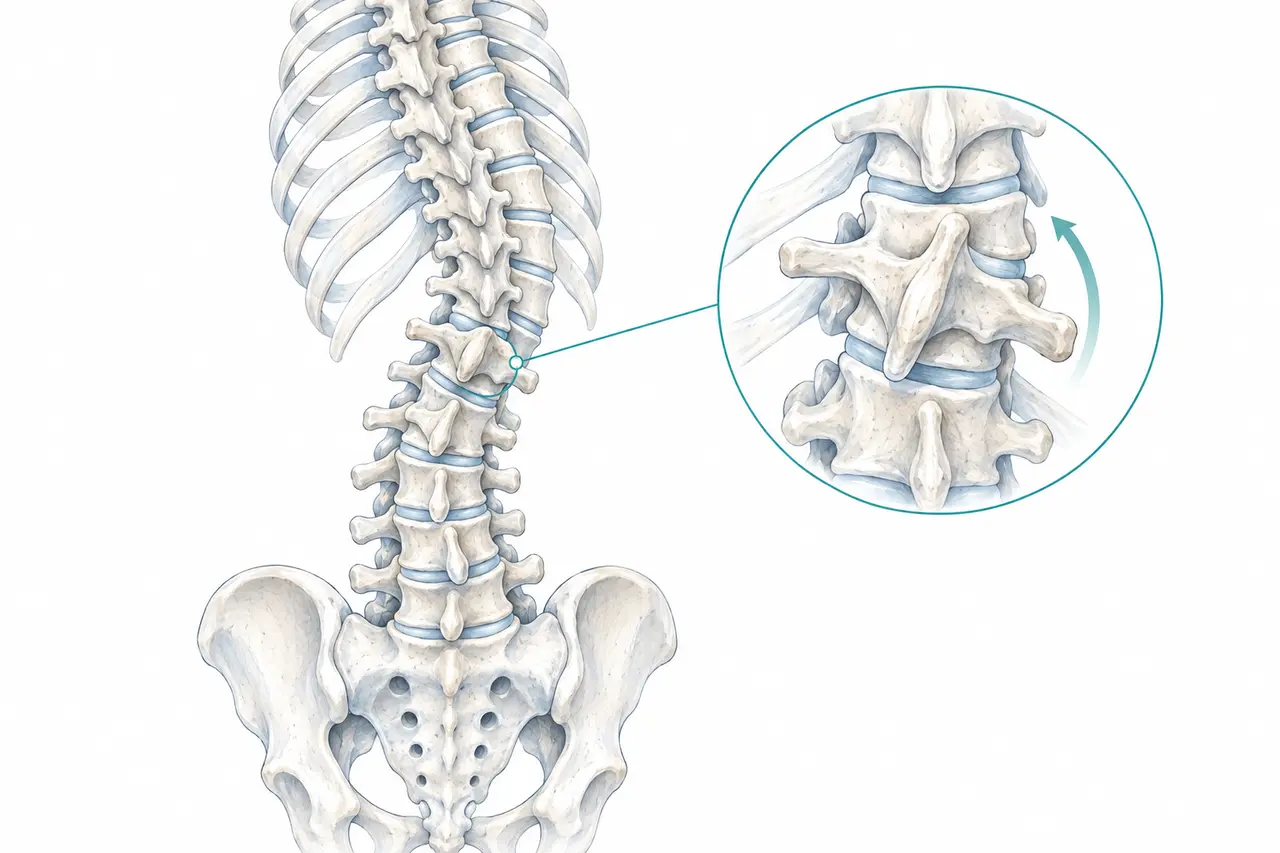
Scoliosis involves both a sideways curve and rotation. Treatment depends on the curve pattern, growth and change over time.In this article
After a scoliosis diagnosis, families often want to know whether the curve will get worse and whether an operation is inevitable. Many young people need observation rather than surgery. The first task is to understand the type of curve and its risk of progression.
What are we measuring?
Scoliosis is a three-dimensional change in spinal shape, including a sideways curve and rotation. The Cobb angle measures the curve on a standing X-ray, but does not describe the whole deformity. Growth remaining, balance, flexibility and changes on earlier images also matter.
This article concerns adolescent idiopathic scoliosis. Scoliosis in a very young child, a curve related to another condition and adult spinal deformity need different treatment frameworks.
When is observation appropriate?
I monitor small, stable curves, commonly below about 25 degrees, with planned reviews during growth. I track changes in the curve and growth remaining to decide when treatment needs to change.
When can a brace help?
A brace is commonly considered for a growing adolescent with a curve around 25 to 45 degrees; progression and growth can justify bracing outside that approximate range. Its main purpose is to reduce the risk of worsening during growth.
The fit and the prescribed wearing time matter. Discomfort, school, clothing and body image deserve practical discussion so the treatment is manageable. Exercises may support function and form part of care, but should not replace an indicated brace.
When should surgery be discussed?
Discussion often begins around 45 to 50 degrees, especially when the curve is progressing or likely to keep worsening. These are guides, not automatic thresholds. Near maturity, a stable curve and a rapidly progressing curve may lead to different recommendations.
If surgery is appropriate, the plan should explain which curves need correction, where fusion would start and end, and how the remaining spine is expected to balance. Preserving motion matters, but a shorter fusion is useful only if it also treats the deformity adequately. Tethering is a separate option for a selected group of growing patients.
Did posture cause this? Can my child stay active?
Idiopathic scoliosis is not caused by poor posture or by a parent doing something wrong. Normal activity is generally encouraged, with advice adapted to symptoms and treatment. Persistent or unusual pain, weakness or other atypical features should be assessed rather than automatically attributed to the curve.
How do we judge surgical success?
When surgery is appropriate, I define its goals around curve correction, overall balance, the levels that need fusion and daily function. A percentage based only on correction of the Cobb angle does not describe the whole result. I explain what the proposed plan is intended to achieve over time.
I look beyond the angle to what the proposed treatment means for the young person: growth, movement, school, confidence and life after treatment. A useful plan explains both the next step and what would make us reconsider it.