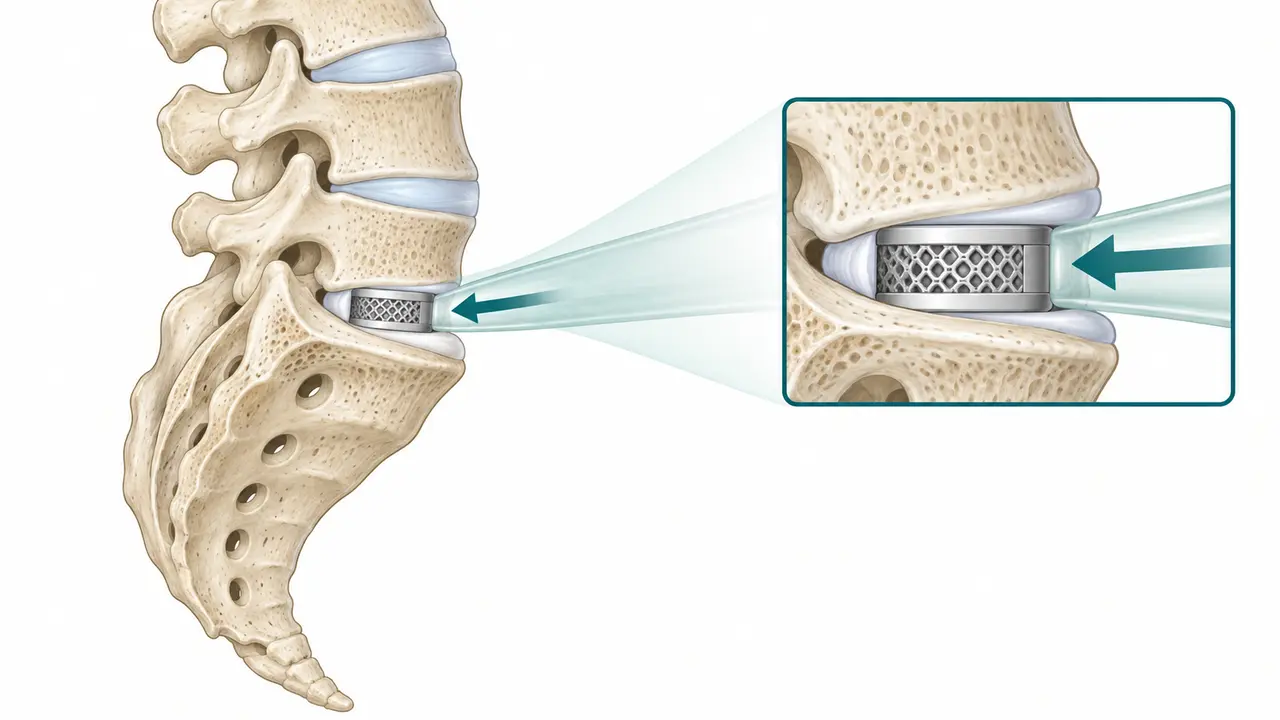
At L5–S1, the approach comes from the front; the cage sits in the disc space between L5 and the sacrum.In this article
An incision in the abdomen can sound surprising when the problem is in your back. The reason for considering ALIF is access: in some cases, reaching the disc from the front helps achieve a specific reconstruction while avoiding a previously operated or sensitive area at the back.
What happens during ALIF?
ALIF means anterior lumbar interbody fusion. The damaged disc is removed and a spacer, often called a cage, is placed between the vertebrae with material intended to support bone fusion.
The usual access is behind the lining of the abdominal cavity. Organs and major blood vessels are carefully moved aside; the operation is not performed through the stomach or bowel. The access itself requires expertise, and an access or vascular surgeon may be involved.
What can the anterior approach offer?
The anterior approach allows a broad implant to restore disc height and the local lumbar curve. During this stage, I reach the disc without dissecting the back muscles or retracting the nerve roots from behind.
I consider ALIF for disc-space collapse, vertebral slippage, reconstruction after previous surgery or spinal deformity when these findings explain the symptoms and this route suits the reconstruction.
Can it relieve pressure without exposing the nerve?
Restoring height can enlarge the opening through which a nerve leaves the spine. This is called indirect decompression. It is useful only when the anatomy is suitable: fixed bony narrowing or other persistent compression may still require direct decompression.
Why might screws from the back also be needed?
Additional fixation supports stability while the fusion heals. I decide whether posterior screws or direct nerve decompression are needed from the diagnosis, bone quality, alignment and implant strategy, and explain the purpose of each stage.
What risks are particular to this approach?
Important risks include injury to major blood vessels with bleeding or clotting, injury to abdominal structures, temporary slowing of the bowel and abdominal wall problems. In men, injury to sympathetic nerve pathways can cause retrograde ejaculation, in which semen travels towards the bladder; this may affect fertility and needs a direct discussion before surgery.
ALIF also carries fusion-related risks, including infection, failure of bone union, implant settling or movement and persistent symptoms. Previous abdominal surgery, vascular anatomy and bone health can change whether this approach is suitable.
How do we define a successful result?
I define success around the purpose of the reconstruction: the intended alignment, fusion and improvement in symptoms and function. The anterior approach is a route to that goal. Any success estimate must describe the full planned operation, including additional decompression or fixation when required.
I choose the route around the reconstruction that is needed. The discussion should explain why ALIF fits your anatomy, what another approach could offer and whether an additional procedure is necessary.