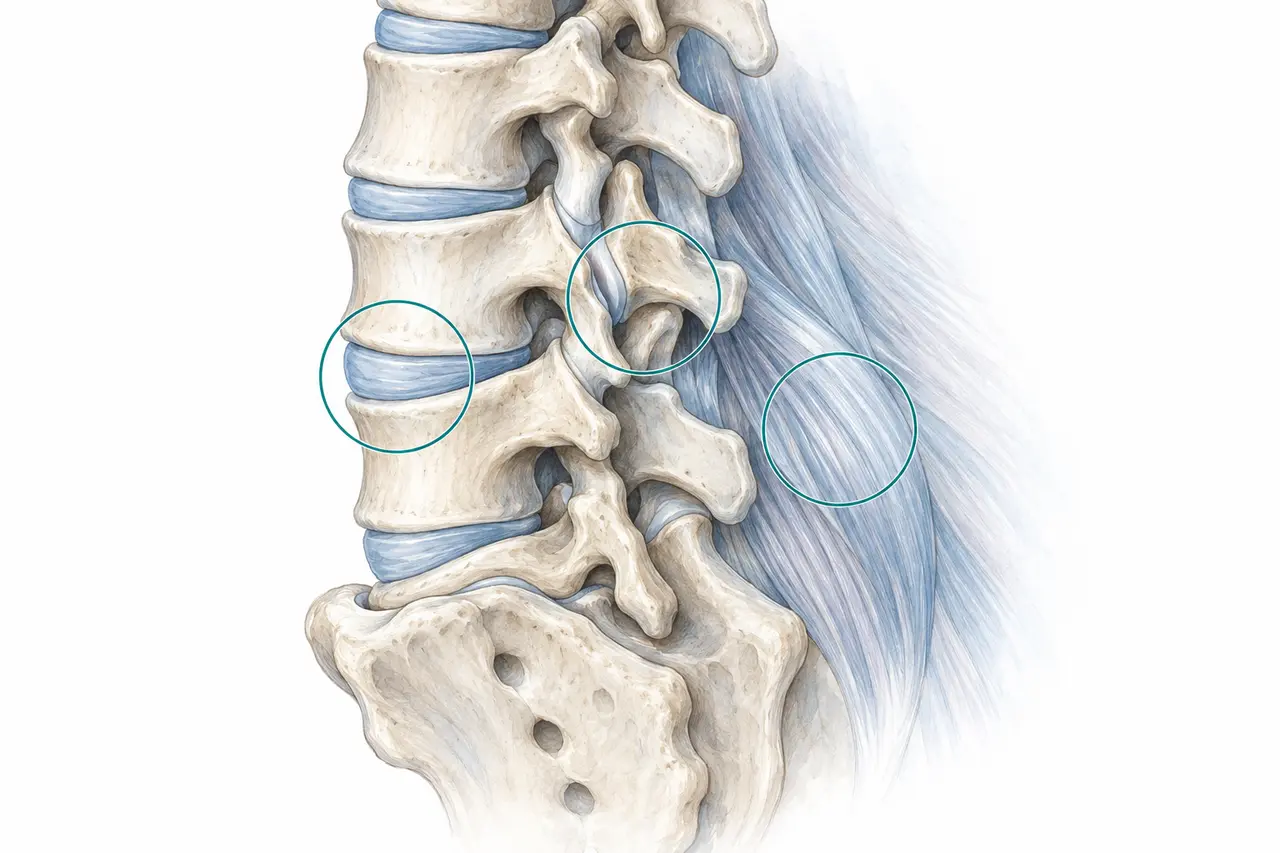
Discs, small spinal joints and surrounding muscles can all contribute to back pain. The assessment looks for the explanation that fits your symptoms.In this article
Persistent back pain needs a clear explanation and a treatment plan. I identify the factors contributing to your pain, establish what can be treated and choose the next step around your movement and daily life.
Start with function, not a procedure
I assess the pain pattern, examination, medical history and imaging when indicated. I connect disc, joint or endplate findings with your symptoms to identify the most relevant treatment target.
For many people, care begins with manageable activity, exercise or physiotherapy, and a review of medicines. I also address sleep, general health and confidence in movement as part of treating the pain and restoring function.
When might an injection help?
An injection may aim to relieve symptoms or test whether a particular structure contributes to pain. An epidural or nerve-root injection is usually discussed for suitable nerve-related leg pain, rather than as a general solution for all back pain.
Relief may be temporary. A response to local anaesthetic supports a diagnosis but does not prove it, and an unsuccessful injection should prompt a review of the reasoning. Injections have risks, including infection, bleeding and nerve injury; medicines that affect bleeding need specific review.
What is facet radiofrequency treatment?
In selected patients with pain thought to arise from the small joints at the back of the spine, diagnostic medial-branch blocks can help assess suitability. Radiofrequency treatment targets the small nerve branches carrying pain from those joints. It does not remove arthritis or fuse the spine, and relief may wear off as nerves recover.
What about newer treatments?
Basivertebral nerve ablation targets pain signalling within the vertebral body. I assess suitability from the pattern of persistent low-back pain, characteristic endplate changes on MRI, previous treatment and evaluation of other possible causes.
Restorative neurostimulation uses an implanted system to activate deep stabilising muscles in selected patients with chronic mechanical low-back pain and impaired muscle control. I assess muscle function and exclude a surgical cause such as significant nerve compression before considering this treatment, which involves implantation and continuing therapy.
I compare the evidence, expected benefit, risks and availability of each treatment against your findings. The plan includes a clear goal and a review of your response.
Where does surgery fit?
I recommend surgery when a defined structural problem explains your symptoms and can be treated effectively—for example, nerve compression, instability or deformity. The diagnosis determines whether you need decompression, stabilisation or correction.
My role is to identify the cause, explain the treatment choices and guide a plan with a clear purpose: less pain, better movement and a return to the activities that matter to you.