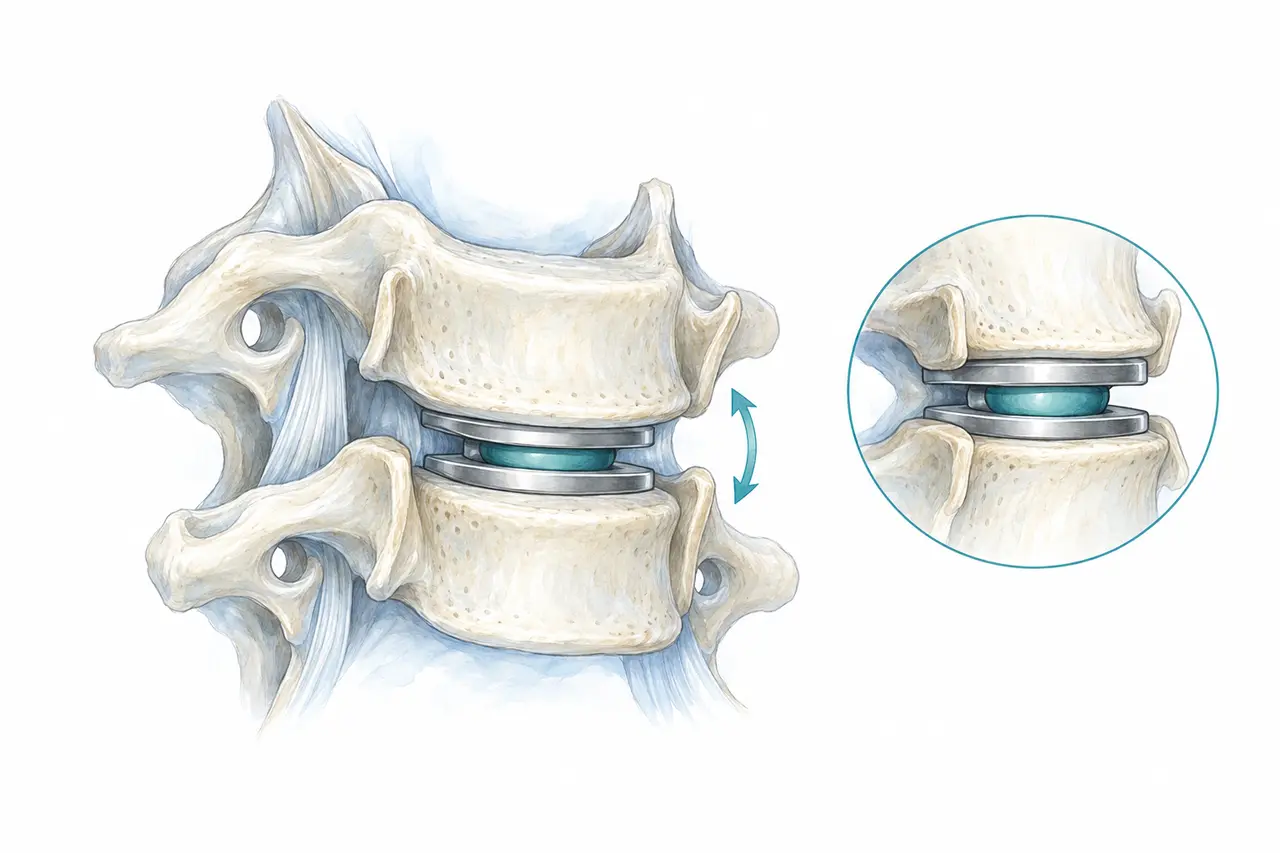
An artificial disc aims to retain movement between selected neck vertebrae. Suitability depends on the condition of the whole motion segment.In this article
If neck surgery has been recommended, you may be concerned about stiffness or the effect on the rest of your neck. I choose between disc replacement and fusion by assessing movement, stability and the condition of the affected levels.
What do the two operations have in common?
Both usually use an approach from the front of the neck to remove a diseased disc and relieve pressure on a nerve root or the spinal cord. In anterior cervical discectomy and fusion (ACDF), the intention is for the vertebrae to heal together. Disc replacement uses an implant designed to allow movement instead.
I establish the reason for surgery first: relieving nerve root or spinal cord compression that matches the examination and your symptoms. Your neurological function and response to non-surgical treatment guide the timing.
When is movement worth preserving?
I assess the affected level’s movement, stability, alignment, facet joints and bone quality. Severe facet arthritis, marked instability, poor bone quality or an unsuitable deformity may make fusion more appropriate. An MRI alone does not show all these features; movement X-rays or other imaging may be needed.
Disc replacement preserves movement at the treated level; fusion stabilises it. The effect on overall neck movement depends on the number of levels treated and their movement before surgery. Neighbouring levels can change over time after either operation.
Can replacement and fusion be combined?
In selected multilevel cases, I use an artificial disc at one level and fusion at another. This hybrid plan follows the anatomy at each level, the evidence for the combination and the approved indications of the implant.
What risks should be discussed?
Both operations carry risks such as swallowing difficulty, voice change, infection, bleeding and nerve or spinal cord injury. With an artificial disc, the implant can settle or move, and bone formation around it may reduce or stop its motion. Device-related problems or persistent symptoms can lead to further surgery. Fusion has its own risks, including failure of bone union.
I discuss relief of arm pain, spinal cord function and neck pain separately. The severity and duration of nerve compression help guide expectations for neurological recovery.
What happens after surgery?
I guide a gradual return to daily activity and exercise, with follow-up to assess healing, neurological recovery and implant position.
How do we compare the expected results?
I first define the neurological goal, then assess whether the operated segment needs preserved movement or fusion. Relief of arm symptoms, protection of spinal cord function, movement and the need for later surgery are separate outcomes. I use the outcomes relevant to your condition when comparing the options.
My priority is adequate decompression and a mechanically sound result. I preserve movement when the segment can support it and use fusion when stability is the more important need.