Endoscopic spine surgery: when does the smaller approach help?
A smaller incision sounds appealing, particularly when you are already worried about an operation on your spine. But the useful question is more precise: can an endoscope reach the problem, treat it completely and leave the spine stable?
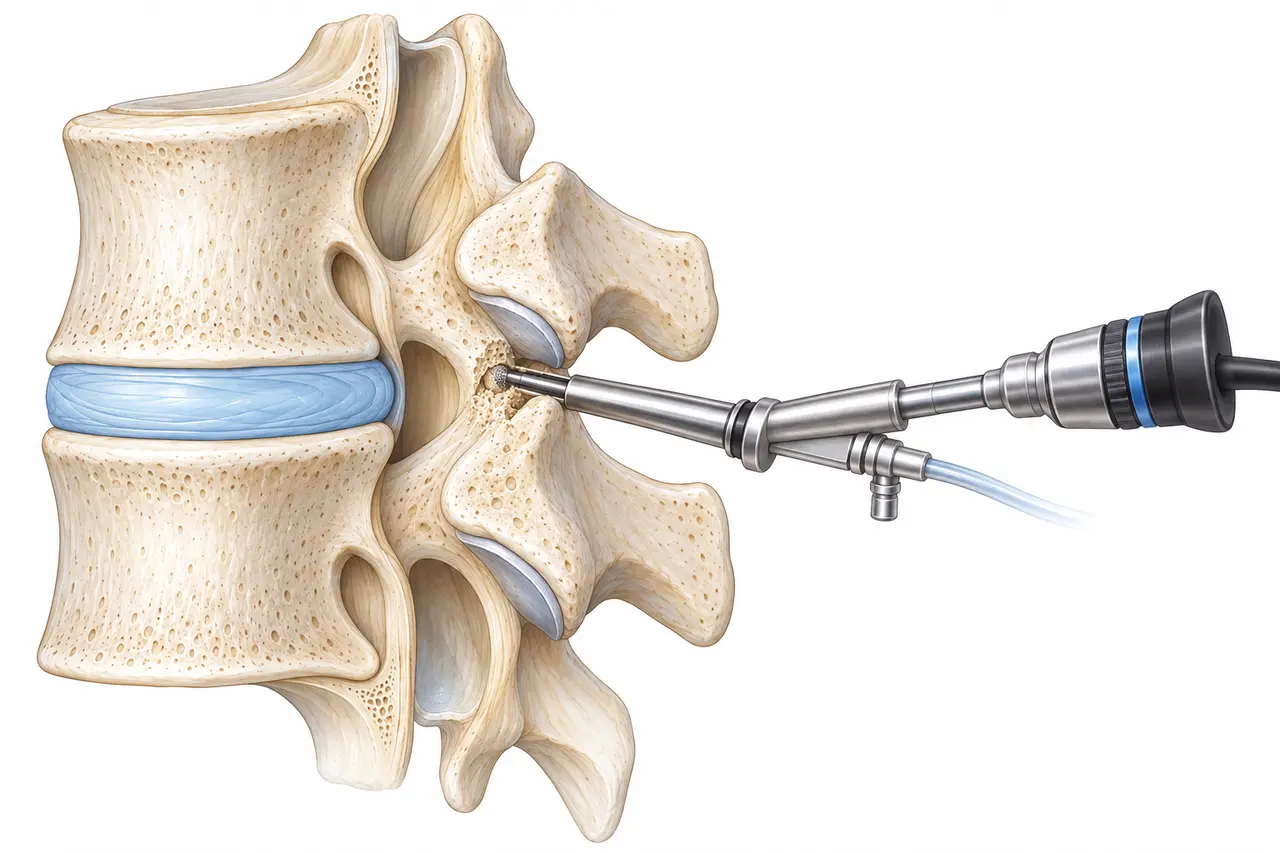
An endoscopic working channel approaches the bony margin of a lumbar nerve opening from the side. The nerve is omitted from this schematic.In this article
What happens during endoscopic surgery?
An endoscope is a narrow camera introduced through a small working channel. The surgeon sees the nerve and surrounding structures on a screen and uses fine instruments through the channel to remove a disc fragment or selected bone and ligament. The route may pass between structures at the back of the spine or approach the nerve opening from the side. The route depends on where the pressure lies.
I use the working channel to reach the affected nerve precisely, with careful protection of the surrounding tissues.
Where might it have a particular advantage?
Endoscopy can be useful for a precisely located disc herniation or narrowing of the foramen—the opening where a nerve exits the spine. A side approach can reach certain foraminal problems while limiting dissection of the back muscles. The working channel can also facilitate access when the spine lies deeper beneath the skin. I choose this approach when these advantages fit the anatomy and the site of compression.
The decision begins by matching the symptoms and examination to the exact site of compression on imaging. If there are several causes of pain, treating one narrow area may leave the main problem untouched.
When might another operation be better?
Some nerves need a wider or differently angled decompression than a particular endoscopic route can safely provide. Marked instability, a deformity that needs correction or a problem requiring reconstruction may call for a different plan. Previous surgery, the shape of the foramen and the position of a disc fragment also change the available route.
Microscopic and other minimally invasive techniques offer alternative routes. I choose the approach that gives me the access needed for a thorough decompression.
What can I expect, and what are the limits?
When a compressed nerve is the clear source of leg pain, the aim is to relieve that pressure. Back pain has more than one cause and is less predictable. Numbness or weakness that has been present for a long time may recover incompletely. Recovery instructions vary with the procedure and the patient's condition.
Risks include infection, bleeding, nerve injury, a tear of the covering around the nerves, persistent or recurrent symptoms and the possibility of another operation. I explain how these apply to the planned procedure and what recovery should involve.
What should I ask before deciding?
Ask which nerve is affected, where it is compressed, why the proposed route can reach it and what would change the plan during surgery. If the answer rests mainly on the size of the incision, the reasoning is incomplete.
What should a success percentage describe?
I assess success by relief of the symptoms caused by nerve compression and improvement in function. The endoscope must provide the access needed to achieve that goal. I select it for the diagnosis and anatomy, then explain the expected result for the actual procedure being performed.
The endoscope is one of several ways to solve a defined problem. I use it when its access suits the anatomy and the treatment goal; the important result is adequate nerve relief with an appropriate operation, not the smallest possible incision.