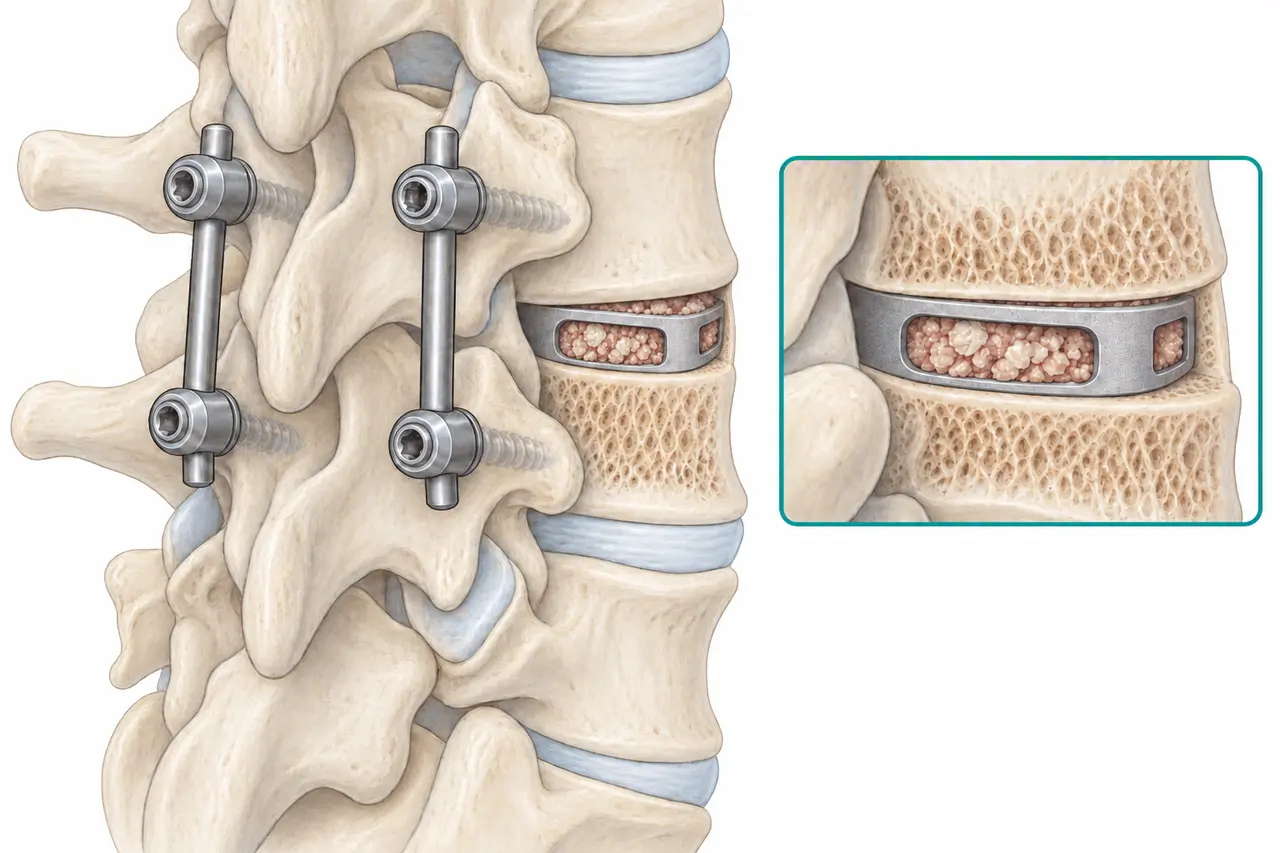
An example of TLIF: an interbody cage and bone graft sit between the vertebrae, while posterior screws and rods provide support as fusion develops.In this article
It is reasonable to pause when an operation is intended to remove movement from part of your spine. Fusion can provide needed stability or correction, but you should understand why it belongs in your treatment plan.
Fusion encourages two or more vertebrae to heal together with bone. Screws, rods or cages may hold the area stable while that happens; the implants and the biological healing are different parts of the treatment.
1. What problem would fusion treat?
Ask for the diagnosis in plain language. Instability, a deformity or a reconstruction after decompression may provide a reason for fusion. Back pain or disc wear on an MRI, on their own, do not establish that fusion will help.
2. Why would decompression alone not be enough?
Decompression creates room for a nerve or the spinal cord. Fusion addresses movement, stability or alignment. Some patients need only decompression; others need both because of existing instability, deformity or the amount of tissue that must be removed. The reason for combining them should be explicit.
3. Why are these particular levels included?
Every level in the plan should serve a purpose. Fusing more levels changes more movement and increases the extent of surgery, but stopping too short can also leave a problem untreated or produce an unbalanced reconstruction. The appropriate length follows the diagnosis, alignment and remaining healthy segments.
4. What are the alternatives, including waiting?
Depending on the condition, options may include continued non-operative care, a targeted injection, decompression alone or a motion-preserving procedure. Ask what each can realistically achieve and what is likely to happen if you defer surgery. Worsening neurological function can change how safely you can wait.
5. What benefit and risks should I expect?
I define the main goal with you: relief of arm or leg pain, improved walking, greater stability or correction of a deformity. We assess each outcome separately.
Risks include infection, bleeding, nerve injury, failure of the bones to unite, implant problems and persistent pain. Further surgery may be needed. Adjacent levels can change over time, although ageing also contributes. Bone health, smoking and other medical conditions influence risk and healing.
How much movement will I lose?
It depends on where the fusion is, how many levels are included and how much movement those levels had beforehand. A short cervical fusion and a long lumbar reconstruction have very different implications. Ask how your proposed operation may affect the activities that matter to you and what rehabilitation will involve.
What does a fusion success rate measure?
Bone fusion, relief of symptoms and improvement in daily function are different outcomes. I explain each separately and connect the expected benefit to the problem being treated. A solid fusion matters, but it does not by itself describe how much better you will feel or function.
My aim is a fusion with a clear purpose and an appropriate extent. Before deciding, you should be able to explain in your own words what the operation is intended to improve and what it may leave unchanged.