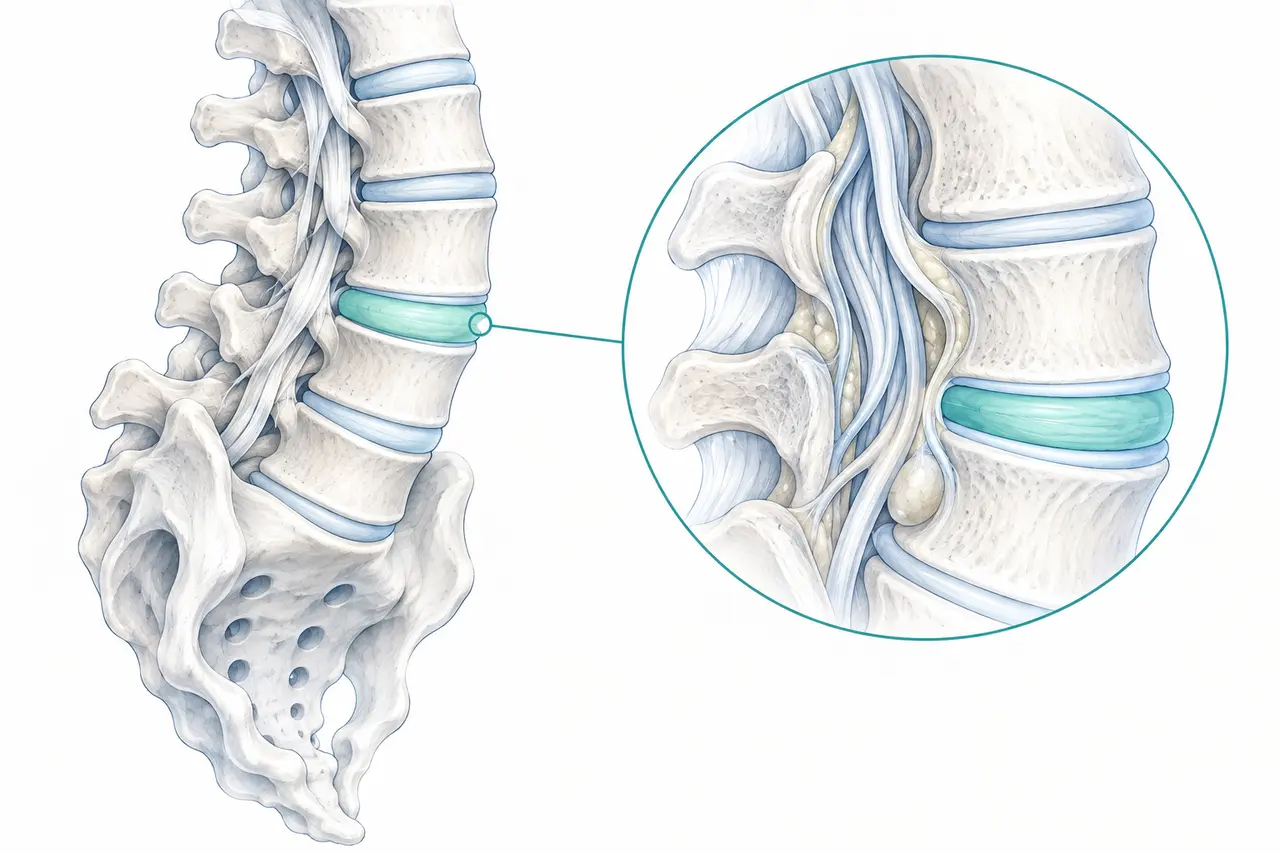
MRI shows the discs, bones and surrounding soft tissues. The findings need to be read alongside your symptoms and examination.In this article
Words such as “degeneration”, “bulge” or “severe narrowing” can make an MRI report alarming to read. They describe what the scan shows; they do not, by themselves, tell you how serious your condition is or whether you need surgery.
What do the common terms mean?
Disc degeneration describes changes in the discs between the vertebrae, often including loss of water or height. These changes become more common with age and can be present without pain.
A disc bulge is a broad extension beyond the disc’s usual boundary. A herniation is a more localised displacement of disc material. Either may be relevant, but size alone does not determine the symptoms.
Stenosis means narrowing of the spinal canal or of an opening through which a nerve leaves the spine. Its importance depends on the location, the degree of compression and the neurological assessment.
Which finding explains my symptoms?
I compare the scan with the history and examination: where the pain travels, which movements provoke it, and whether there is weakness, altered sensation or a change in walking. The affected level and side should make clinical sense.
When the findings do not fit your symptoms, I reassess the diagnosis and look for the cause. The severity of pain and the size of an MRI finding do not always correspond.
Does “severe” mean I need surgery?
I judge the importance of narrowing by its effect on nerve and spinal cord function. Changes in hand dexterity, balance or walking deserve particular attention, even when neck pain is mild. The examination determines whether treatment or planned follow-up is appropriate.
Standing X-rays, movement views or CT answer questions about alignment, stability or bone anatomy that MRI alone may not resolve. I request them when they will help establish the diagnosis or plan treatment.
What should I bring to a consultation?
Bring the actual images as well as the written report, any earlier studies and a short account of how your symptoms have changed. A report alone may leave important questions unanswered.
A useful MRI review should leave you understanding which findings matter, which may be incidental and what still needs to be clarified. The aim is a decision about your care, not a treatment for every phrase in the report.