Lumbar spinal stenosis: when walking becomes difficult
Leg pain, heaviness or numbness during walking can come from narrowing around the nerves in the lower back. Treatment depends on the symptoms, the examination and what the narrowing is preventing you from doing.
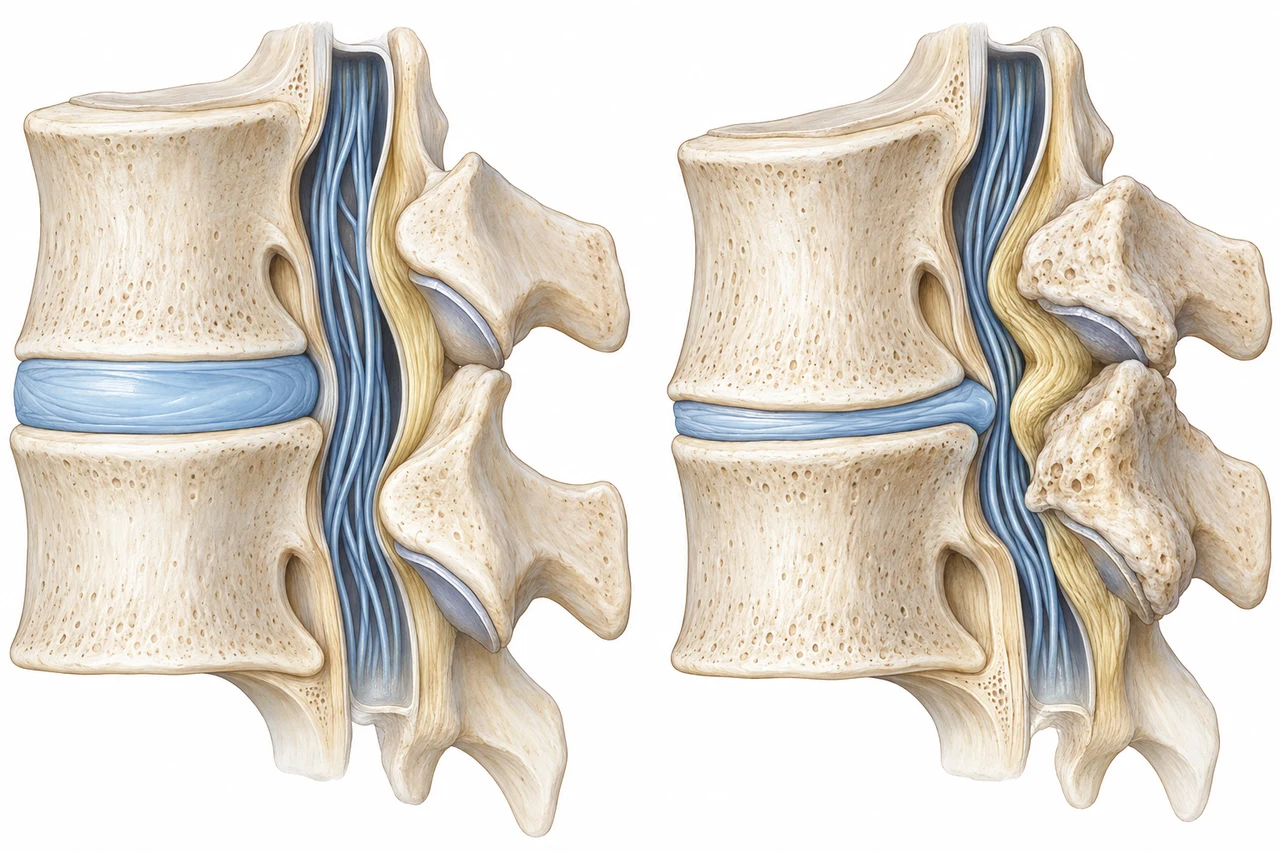
Left: preserved disc height and more room for the nerves. Right: disc-height loss, enlarged facet joints and thickened ligamentum flavum can combine to narrow the nerve passage. A simplified comparison, not before-and-after treatment images.In this article
You may still feel able to walk, yet your legs force you to stop. Sitting down helps, and you can start again—only for the same symptoms to return. When this begins to limit an ordinary walk or a trip to the shops, the important question is what is causing it and what can restore useful activity.
What does “stenosis” mean?
Stenosis means narrowing. In the lower back, it can affect the central spinal canal or the smaller passages through which individual nerves travel. Changes in the discs, joints and ligaments can gradually reduce this space; some people also start with a naturally narrower canal.
A bulging intervertebral disc may contribute, but stenosis is not simply another name for a herniated disc. Several structures may be involved. This article concerns the lumbar spine; narrowing in the neck can affect the spinal cord and requires a different assessment.
Why do standing and walking bring on symptoms?
Leg aching, heaviness, tingling or weakness may develop with standing or walking and ease with sitting or leaning forward. This pattern is called neurogenic claudication. Some people can cycle or walk leaning on a shopping trolley more comfortably than they can walk upright. Back pain may be present, but it is not always the main problem.
I also check for poor circulation, hip disease and peripheral nerve disorders, which can limit walking alongside spinal stenosis. The examination helps identify which problem is responsible for your symptoms.
Does a severe MRI finding mean I need surgery?
No. The scan shows where space is reduced; it does not measure how much the condition affects your life. I look for agreement between the symptoms, the examination and the level and side of the narrowing. Standing X-rays, and sometimes movement views, help when alignment or stability may influence treatment.
Walking distance, muscle strength and independence in daily life guide the decision. I recommend treatment for the clinical problem and its effect on your function.
What can help without an operation?
I use tailored exercise or physiotherapy, activity pacing and appropriate pain medication to maintain strength and improve daily function. These treatments can improve symptoms even though the bony narrowing remains.
Injections do not widen the canal. A targeted injection may be discussed for selected nerve-root pain, but the benefit may be temporary. Epidural injections are not routinely recommended for the walking-related symptoms of central canal stenosis.
Progress should be judged against something meaningful to you: walking farther, standing to cook or sleeping with less leg pain. If these remain difficult, the plan needs reassessment.
When is surgery worth considering?
I recommend surgery when nerve-related symptoms continue to restrict life despite appropriate non-surgical care, and the examination and imaging identify a treatable cause. Progressive weakness can require earlier surgery. New bladder or bowel dysfunction needs emergency assessment.
During decompression, I remove the tissue pressing on the affected nerves. I select a conventional, microscopic or endoscopic approach that provides the access needed to relieve pressure while preserving stability.
The main aim is usually to improve leg symptoms and walking. Back pain is less predictable, and longstanding numbness or weakness may not fully recover. Risks include infection, bleeding, a tear in the nerve covering with fluid leakage, nerve injury, persistent symptoms and later instability or further surgery.
Will I also need screws and fusion?
Many patients need decompression alone. I add fusion when there is significant instability, a deformity requiring correction or a decompression that would otherwise leave the spine unstable. I assess these features directly, including when a vertebra has slipped.
I consider the balance of the spine, the condition of the joints, previous surgery and how much tissue must be removed. Each added level should serve a clear purpose. You should understand why decompression alone is sufficient—or why it is not.
What improvement does success refer to?
I define the expected benefit in terms of walking, standing tolerance and the leg symptoms caused by nerve compression. Back pain and longstanding nerve dysfunction need their own assessment. I explain which outcomes a quoted percentage measures and how they relate to the operation I am recommending.
My starting point is the activity you are losing and the reason you are losing it. The right plan may be continued non-operative care, a focused decompression or, when necessary, a reconstruction. The aim is to protect neurological function and improve everyday life with an operation only when it has a clear purpose.