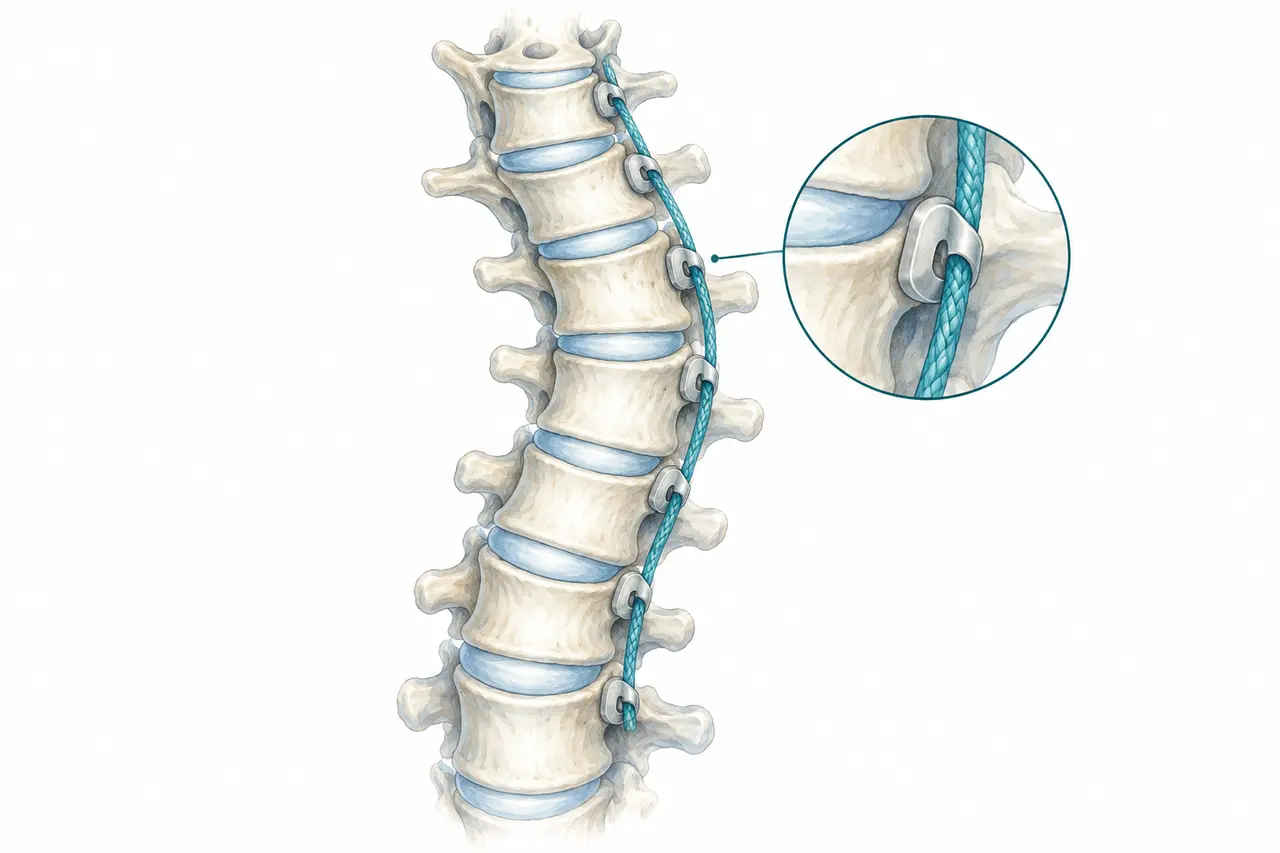
A flexible tether links anchors along the outer side of a scoliosis curve. Its effect depends on remaining growth and careful patient selection.In this article
Vertebral body tethering, or VBT, treats selected scoliosis curves while preserving movement. I assess remaining growth, curve flexibility and balance to decide whether tethering or fusion offers the right correction for the young person.
How does the tether work?
Screws placed in the vertebral bodies on the convex, or outer, side of the curve are joined by a flexible cord. Tension provides an initial correction. During further growth, the tether restrains the outer side while the inner side can continue growing, which may gradually reduce the curve.
Because the treated vertebrae are not intentionally fused, movement can be retained. The final correction is not fully determined on the day of surgery: later growth and the behaviour of the tether also matter.
Who may be considered?
The assessment includes remaining skeletal growth, curve size and flexibility, curve pattern, progression and previous brace treatment. Skeletal maturity is assessed from the examination and imaging; age alone is not enough.
Too little growth can limit further correction. Too much can produce overcorrection. A rigid curve or an unsuitable pattern may be better treated by another strategy. Growth-based tethering should not be presented as an established equivalent for an adult whose growth is complete.
What can go wrong?
The curve may remain larger than intended, continue to progress or overcorrect. A tether can break and screws can loosen. Further surgery may involve adjusting or replacing the tether, releasing it or converting to fusion. A broken tether does not automatically require another operation; symptoms and the behaviour of the curve guide that decision.
VBT carries risks including bleeding, infection, nerve injury and chest or lung complications with thoracic access. Follow-up through growth tracks correction, balance and the condition of the tether.
How should we compare it with fusion?
Fusion has a longer clinical track record and generally more predictable correction. VBT preserves movement in selected patients, with the result influenced by later growth and tether durability. I compare these features and the likelihood of further surgery for the specific curve.
Ask how the expected correction, remaining movement, follow-up burden and possible later procedures compare for this particular curve. Device indications and availability also differ between countries and centres.
What does success mean during growth?
For VBT, I discuss curve control through growth, balance, retained movement and the possibility of another operation. Early correction is one stage of the result. A meaningful estimate needs to state the follow-up period and whether later revision or fusion is included in the outcome.
I plan for balance, useful movement and a durable result through growth and beyond. The choice follows the curve, the growth remaining and the long-term needs of the young person.